

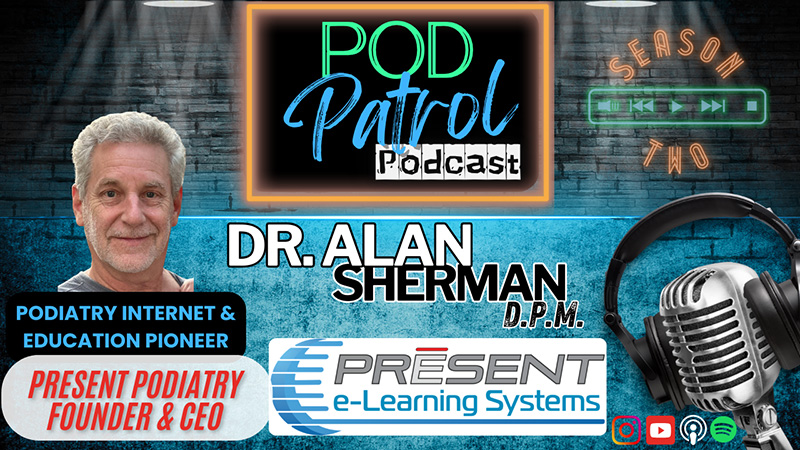
Jeff Dikis Interview of Alan Sherman on Pod Patrol Podcast
Pod Patrol is a new podcast for the podiatry community. If you haven’t discovered it yet, you are missing out! Launched in 2024, the podcast features notable guests from around the country, who bring fresh insight, clinical pearls, and cutting-edge surgical techniques. Hosted by Jeffrey Dikis, DPM, the show combines storytelling with practical education, making even complex topics approachable. Listeners tune in to learn, get insight and become inspired by one another. Designed to be both informative and entertaining, Pod Patrol delivers medical education and career mentorship in a way that is easily viewed or listened to from any of your devices. You can choose the episodes that interest you the most at the home of all things Pod Patrol, https://www.podpatrolpodcast.com
The latest episode features an interview with PRESENT Podiatry co-founder and podiatry Internet visionary Alan Sherman, DPM.
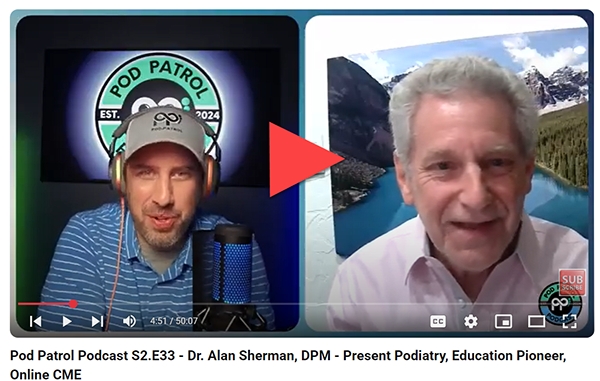
In this episode, Dr Jeffrey Dikis interviews Dr Alan Sherman, who shares his journey in the field of podiatry and the evolution of medical education. Dr Sherman discusses his early experiences with technology, the founding of Podiatry Online, and the transition to providing educational solutions for podiatrists. He emphasizes the impact of technology and AI on medical education, the changes in the podiatry field over the years, and the importance of adapting to new educational methods. The conversation highlights the challenges and opportunities in continuing education for podiatrists, especially in the wake of the COVID-19 pandemic. He unveils his new AI-driven solution for PRESENT Podiatry and discusses what goes in to creating such a project. Check out Podiatry.com for more information.

Dr. Dikis(00:21)
All right, welcome back to another episode of Pod Patrol with your host, Dr. Jeff Dikis. Tonight, I am joined by Dr. Alan Sherman. Thanks for joining me tonight.
Dr. Sherman
Oh, thank you so much for inviting me. It's a pleasure to be with you tonight.
Dr. Dikis
Absolutely. So for anyone who doesn't know who you are, I assume most people do know, but there may be some who don't know. Why don't you go ahead and introduce yourself and give us a quick little background of your career. And then we'll kind of dive deeper into some of those things.
Dr. Sherman(00:46)
Sure. I had been in practice from 1981 to 2005 in Delray Beach, Florida. And that was my first love.
But I was always kind of a geeky guy, like a lot of our colleagues are. So many doctors are science majors and love technology. And I practiced in the town of Delray Beach, right next to Boca Raton, where the IBM PC was developed and then manufactured for many years. So from 81 on, I had the IBM engineers coming in telling me what an exciting thing this was and how it was going to change everything. And I and some of my doctor friends became sort of computer hobbyists. We would buy the first computers that would come out when the memory would come out, when the new operating system would come out, we would be the first to get them and we would soup up the computers and make them as fast and as effective as we could. And we bought a scanner and we did photography on the computers. And then there were computer bulletin boards, which were the precursors of the internet.
So fast forward from 81 to 95 when Mark Andreessen, a brilliant University of Chicago engineer, put out the Mosaic web browser and the internet became available to everyone in 1995. And I was one of the first to download the Mosaic browser and started to learn how to set up a website and set up the Podiatry Online website and it was done right here at my desk in my house. It's the same desk, it's the same house. ⁓ And it was very rudimentary. I learned the HTML programming on my own and was able to put up a website and most importantly a form that the podiatrist could use when they found that site to sign up for the newsletter and Podiatry Online was a newsletter that that went out at first to five people and then 50, then 500, then 5,000. Between 1995 and 2000, it grew to membership of about 8,000 podiatrists.
Dr. Dikis(03:10)
Wow.
Dr. Sherman(03:11)
And what was it? It was a discussion forum. It was a publication. I shared what I learned about practicing. I put up the forms I developed in my practice, the patient information brochures, and put up information that I thought would be helpful for them to learn how to run their practices and treat their patients better.
And so gradually they started sending in questions. And I tried my best to answer the question quickly because sometimes they will click the questions.
Dr. Dikis(03:41)
What? I was gonna say, what kind of questions are they asking you?
Dr. Sherman(03:46)
Questions regarding the care of patients and the running of practices. and, so I would give them the answer and then new questions would come in and, ultimately, they weren't entirely satisfied with my answers and they would write in and they would say, well, in this situation, I use this antibiotic or, I build this code. And, gradually I was able to step back from doing all the writing and just edited this conversation that went on and we got to the point where every day I would get five or 10 letters to the editor, which I would then format into this emailing. And it had gone out once a month and once a week. Eventually it was once a day by the year 2000. And it was taking up a lot of my time. I was still practicing. And my family was wondering why they were always seeing the back of my head and what dad was doing at the computer here.
Dr. Dikis(04:48)
You were solving all the podiatry problems in the world all at once.
Dr. Sherman(04:52)
I was having so much fun, Jeff, just hosting this discussion and it was intellectually stimulating and interesting to me. And about that time, a good friend of mine, Michael Shore, was interested in what I was doing and he said, well, you can make a business out of this.
And I was saying, well, that would be nice. What do you think we should do? So he started trying to sell banner ads. And in the year 99 and 2000, banner ads were mostly being done by high tech companies and not so much medical supply, pharmaceutical and device companies. But he tried and he sold some contracts and I sold a contract to Janssen, a part of J &J and but it was still you know it wasn't anything life-changing and then one day I got a phone call from a woman named Linda Autore and Linda was the CEO newly hired CEO of Moore Medical and you know your audience knows Moore Medical, they were a large supplier to podiatrists at the time and Linda had been hired coincidentally from IBM, which was in Boca Raton. And she was hired by Moore Medical to create an e-sales channel to start marketing on the internet, which was still pretty new in 2000. And so she had brought in enterprise software and she had developed a website for them. And she had heard from a good friend of mine, a podiatrist named Henry Stark, who practices near here.
Dr. Dikis(06:24)
Yeah.
Dr. Sherman(06:37)
She had heard that Dr. Sherman has this internet community and he had a whole lot of email addresses and Linda was interested in using those to market to those people. And the first thing out of her mouth is, I heard about you from Henry Stark, we would like to buy you. And...
Dr. Dikis(06:56)
Hmm.
Dr. Sherman(06:57)
I didn't know the first thing about selling a company. was running a podiatry practice. It was a pretty simple business at that time. It's gotten a little more complex since then. So I talked to Michael. said, I get back to you. I talked to Michael about this. Michael got all excited and Michael brought in his cousin, Vic Weinstein, who was a fascinating guy who had built and sold a company already. So Vic was one of the founders of the American Board of Emergency Medicine. He was an emergency physician. And he had developed the model of outsourcing the running of emergency rooms. And he was flying all over the country, signing up hospitals to outsource the running of the emergency departments. He eventually went on to do radiology and pathology. Vic agreed to help us with the sale of podiatry online and he brought in a very talented attorney and we started negotiating with Moore Medical and I can tell you that whenever we were in a meeting with Moore Medical, Vic and the attorney were the smartest guys in the room and we did this dance with them for three months and they eventually bought us. And part of the buying of us was having us continue to run the service. And we did that for a couple of years. But ultimately, they continued to employ us for a couple of years until 2002 when their plan all along was to get acquired. So Moore Medical received an offer to buy them by McKesson, the hospital supply company. And McKesson eventually bought More Medical and they made Linda's stock worth a fortune. did really well. The first thing they did was they fired her and they took over the running of the company and they outsourced the running of Podiatry Online, to a company that was doing something similar in the field of emergency medicine, actually, coincidentally, and in nine months, it was gone.
Dr. Dikis(08:55)
Hmm. Why did, why did they want to buy you? If you were just having some, a few banner ads here and there, did they want the reach that you had or what was their reason for buying you?
Dr. Sherman(09:10)
It turns out, Jeff, they had two reasons at two different levels. One, yes, they wanted the mailing list. They wanted, we had a mailing list of about two thirds of the podiatrists in the country. But more than that, Linda wanted to be acquired by someone. And so she would have us fly up to New Britain, Connecticut twice a year and present to them on how to do marketing to podiatrists.
And we had something called an earn out, which was a clause in the contract to buy us that if we improve the sales to podiatrists, we got an incredible earn out. It turns out that wasn't so easy and the sales to podiatrists just went up a little bit during that time. But the marketing plans that we gave to them were part of their CIM, their Confidential Information Memorandum to get acquired and that was part of why McKesson bought them, because they saw that it had this potential and so in 2002 they were ultimately acquired by McKesson. We were fired and Michael and I were back to our practices and we had had this exciting experience. We've made a bunch of money and we started looking for something else to do and that something else became PRESENT eLearning Systems
We started PRESENT initially as a solution for the residency directors to have formal educational programs that they can offer because in order to be qualified for CMS funding of the residency programs, they had to be doing an hour of formal teaching each week. And you know, back then, a lot of the programs were not in teaching hospitals. They were in community hospitals, special surgery hospitals, and the docs needed help doing that. And initially our solution for them was to do a PowerPoint exchange, to upload everyone's PowerPoint files and allow them to download them and use each other's PowerPoint to do the teaching. But this was 2002 and fast internet connections were starting to become widely available. And I thought we could do better than that and actually create the programming.
Dr. Dikis(11:22)
Sure.
Dr. Sherman(11:26)
So I started researching what that would take and we adopted this early technology for recording lectures. In the first year, we developed the curriculum for the first year residents and then the next year we did the second and third. So we eventually had one lecture a week for each of the residents while they're in their three year programs.
And it was a subscription model, still is, and the hospitals bought the subscriptions and that was our first product, called PRESENT for Residency Education.
Dr. Dikis(11:58)
Yeah, I think that makes a whole lot of sense. So it's interesting to see the dynamic of what you started with and then kind of adapting as technology changes, right? So, and early on there was no, no chance you could do high resolution video and video, live video conferencing, right? The internet speeds were just, if you could get an internet text website to load. I was happy if my dial-up went through, if it didn't get a busy signal. If you got the internet website to load and you can get that information. What people are used to from a technological standpoint is going to change with time. If you still have the same model today where it was just text-based that may not appease every single person who's used to having high speed internet and video and high definition this and high definition that. Have you seen present kind of change from its initial, like you said, with the residencies to where you're at now with managing multiple conferences and all the information that's out there. How have you seen that flow change through the years?
Dr. Sherman(13:07)
Well, I mean, you're living it, Jeff. You're doing multi-channel publishing of these podcasts, which is fantastic. ⁓ That all had to be done manually in 2002. So we started with a company called MediaSite. They were sort of a proprietary box that you would get that we would bring to live settings or in our offices in Boca Raton or when we started doing conferences and we would record using Mediasite and eventually we realized that we were better off doing that ourselves and recording pure video. Video became a very ubiquitous, it's all over the place and you know the story of YouTube, the incredible volume of publishing that they're doing.
So, you know, how has it changed? You know, back then we had a simple delivery site. We had to develop a learning management system because, you know, when we were delivering just to the residents, it didn't have to be accredited education. But starting in 2005, we started publishing for CME. And back then we had partners, first the Ohio School, the New York School, were our co-providers to be able to deliver, you know, CPME accredited education. Eventually, we applied for and obtained our own accreditation through CPME. And the learning management system was rudimentary at first, but it's become a very sophisticated piece of software that does a whole lot of stuff now and, we've had this experience over and over again, of needing technology and then I love shopping and the internet is the best shopping mall there has ever been. I again and again shopped for software in order to use that to solve issues that we've had only to find that it wasn't customizable enough and we couldn't make it particular enough for our needs. So we've, through the years, only used our own software. I am lucky enough to have met a fellow named John Garland, who I hired in 2003, I believe, and he is still my IT director and the architect of all of our software. He's brilliant and he's a self learner. He didn't go to college, he taught himself and he now has a family and is a grown-up dude but he was a young guy when he started working for us and he and his front end designer built all that you see and use on the PRESENT Podiatry website. I'm sort of the director of the software development, but I don't do any programming, not since the HTML days. ⁓ so John puts into practice everything that I want on the website.
Dr. Dikis(15:49)
Mm-hmm.
And so today it stores the educational materials, it stores the publishing that we do. ⁓ It is a vending machine for it, so it accepts payments. It issues CME. Over the years we developed the capabilities to issue certificates, PDFs, but they're stored as data on the website. We made the commitment years ago to be the way by which podiatrists keep track of their CME. So when you earn CME from PRESENT, whether it's from the on-demand lectures, the live in person conferences or the virtual conferences or the webinars, we store all of those CMEs and have customers the capabilities now to go to your account and you can print out a transcript so that you can report to your specialty board or hospitals the CME that you have earned. ⁓ Two years ago, we added the capability to keep track of CME that you earn anywhere and you can enter that on the site and that gets stored along with what you've earned with PRESENT. So that's part of the learning management system now.
Dr. Dikis(16:52)
Mm-hmm.
That's really interesting. what role, so you kind of have your foot in multiple arenas with the live conferences and the online CME. I know that some States limit the amount of online CME that you can get as a portion of your total CMEs. Well, how do you, what's your view on live CME versus online CME and which one do you prefer? Which, what are your thoughts on, on each of those? Cause they're, they're quite different or they can be in terms of the experience that people have in a live like, but in seat versus clicking a mouse in front of a computer. What are your thoughts on those and how they differ?
Dr. Sherman(17:48)
We started doing conferences in 2005, it's been 20 years now, and we realized that even though we were early with online, so much of the education was taking place at conferences. We wanted to be a part of that. So we were friends with the people that were doing the Superbones conference with Stan Kalish and John Steinberg, and Richard Reuter. And we talked to them one time and they said, you know, maybe you can help us do some of the logistics of running these meetings. They wanted to do the academic programming. They were good at it. They needed help with the marketing and the management of the meetings. So we went to work with them one year. They found it helpful. The next year we bought the company from them and we continued to work with them to run it. We did the same thing with Bob Frykberg who was running the Desert Foot conference for the VA ⁓We offered help to them and then he allowed us to take that over. Then we started the residency summit conferences. so, you know, there will always be in-person professional conferences. There's a reason why people go to conferences, you know, the collegial aspect, the interpersonal networking, certainly conferences where papers are delivered and research is presented. There will always be that. So we got to the point where we were doing seven conferences a year and then there was a little epidemic called COVID. And COVID shut down so many industries, but it completely shut down the live events industry. Las Vegas was silent. so was McCormick Place and the Javits Center. It was incredible. So we had to learn how to do something like an in-person conference online. So in, you know, in early 2020, I was shopping for live streaming software to run conference online. And it was like the Wild West out there and, you know, not to get into all the technical details, we started with one company and had a kind of a rough experience. We had people waiting, teachers waiting to get on stage, to step up to the podium virtually and something happened and the conversations we were having with them to get them ready were getting broadcast live instead of the lectures and it was difficult. The third one we did with a platform that was much easier to use and we're still using that platform today. We've done over a hundred, maybe a hundred and fifty now streaming conferences. So the world changed and in 2021 we delivered over a hundred thousand CME credits to podiatrists because there was nothing else and many of them knew about us already and that became THE way for podiatrists to get CME. And, you know, fortunately now we've been able to get back to in-person conferences and I really missed them. so all of that, doing all of that is done from our learning management system. And so we've had to add on all these different features in order to accommodate those different types of education.
Dr. Dikis(21:19)
I wonder what percentage of people, know, during the pandemic, nobody could go to, well, a certain portion of the population didn't go to work and they worked from home. And then they got used to that. It was a little too good. And they're like, I'm not going back. I'm working from home. I wonder what percentage of people realize, I can just do my CME from home. I don't have to book a flight. I don't have to book a hotel. I don't have to take time off of work. I don't have to be away from my family. I can just do these CMEs online.
I bet there was a portion of the population who had never considered that before until they needed to. And then they realized, well, this is easy. I'm just going to do this from now on. Cause I do think there's a distinction there between law or I should say online CME is being easy. And in-person CME is being fun. You get to see all your friends, your buddies from residency, people you haven't seen for years. And you meet up after the conference, not only at the physical lectures, but dinners and events outside of it. So they are very different to me. And I think they fill a different niche, but I wonder how many people akin to the people who started working from home and then just said, I'm not going back into the office. They just started doing them online. Did you see a, a residual bump in the online after that unfortunate reason to have a bump in
Dr. Sherman(22:37)
You're absolutely right that that COVID experience changed the nature of education in medicine and many of the people that learn to like that as an alternative to in-person conferences have stuck with it. On-demand CME, the pre-recorded lectures have become our biggest way to deliver CME. And then there's the virtual streaming conferences, the actual conferences that you don't have to leave your home to experience. There, we're finding that different individuals seem to like different media, different formats in this regard. So there are people that get as much CME as they can with on demand. There is no limit in most cases to getting your CME through streaming conferences. CPME considers streaming online equal to in-person in every way.
But different people like different formats. This last couple of years, we developed this DEA Mate training that everyone that has a DEA license has to get. And we deliver that in two different formats, one a live streaming one day event, and that other on-demand. You do it at your own pace.
And while they're both getting a lot of traction, the on-demand gets much more.
Dr. Dikis(24:02)
Yeah, I actually did that. I did your online DEA because that was a new requirement from the DEA that you've had certain number of continuing education credits in that specific training regard. So that was the easiest way to get it. So that makes sense.
Dr. Sherman(24:18)
And that's what people want. They want convenience. And we have this joke that a lot of the people that are attending our streaming or on demand education are not wearing pants. ⁓ You're at home. You do what you want. If you want to go, you know, go and get a sandwich, you're able to. It ultimately it respects the learner because when people go to a conference, though they are in lectures, you know, six or eight hours a day, nobody's paying attention for six or eight hours. It's very demanding. They pay attention to what they're interested in and always have. And on-demand respects that. It lets them learn what they want to learn, when they want to learn it. And even streaming lets them do that to an extent, in that it allows playback of the lectures for up to a month after the event ends. I think the docs don't want to be corralled and they don't want to be treated like children. They're getting the education for two reasons, because it's a regulatory requirement of renewing your license. It's something you have to do. But also they want to keep up and they want to continue to learn. And that's a convenient way to do that.
Dr. Dikis(25:25)
Absolutely. You're joking about people not wearing pants. At least they don't have their cameras on when they're absorbing this information. I was on a meeting one time and someone didn't know they had their camera on and he was laying in bed with no pants on in a hotel room. And it was very uncomfortable because all of us could see everyone else and he didn't know he had his camera on. So at least during these live streams and things there, they're not, ⁓ it's not a two way street.
Dr. Sherman(25:54)
So Jeff, all of this is culminated in a project that I've been working on for the last two years. I'd like to talk about it a little bit if that's okay with you.
Dr. Dikis(26:03)
Absolutely. Tell us about the next advancement in technology.
Dr. Sherman(26:07)
So I'm very excited about this. In the last few years, I came to realize that we've recorded and have a tremendous amount of teaching. It totals over a thousand hours of teaching by people that we've selected that we thought were the best people to teach each particular topic area.
But for the purpose of accessibility, it was in the worst possible format. It was in video. So, you know, when we publish a lecture, we write a description about it. We write a quiz and we have a title for it. And that's all that was searchable. so when if someone had a particular question and they went to the website, they might be directed to a lecture on, you know, rear foot or wound care, but they weren't getting good hits on our searches for particular questions. Then AI was delivered, you know, by ChatPT and Sam Altman. And I realized two years ago that this was a great opportunity for us. So my programmer, John and I had had a series of meetings and we decided that we were going to create an AI based on the teaching that we've recorded. And it presented a whole bunch of interesting technological challenges, but the AI helped us solve, helped us develop the AI. And in the next couple of months, we're going to release access to it. So what did we do?
We designed AI services to listen to all the lectures and transcribe them into text. This transcription turned out to be better, more accurate than the human transcribers that we’ve employed over the years, That’s how good AI transcribing has gotten. We put the transcriptions into a vector model and built a large learning model around it to use all that information. You know, so this is teaching by Harold Schoenhaus and Guido Laporta and Larry DiDomenico and Jarrod Shapiro and Marie Williams. The source material was so respected and well done by our teachers, that the AI coming from it had to be excellent as well if we built it right.
So we released our first model for testing about six months ago. We brought it to one of our meetings. We had our faculty sit down and throw questions at it. And we programmed it so that it would give answers sort of like Up to Date, One page summary answers that were highly outlined. You know, it's not perfect. AIs aren't perfect. Sometimes they give strange answers. But more than 90% of the time it's giving answers that are useful. And we're putting the finishing touches on this. We're going to be releasing this with a new version of our Lecture Hall, the way the lectures are delivered on the site. It's going to be integrated into that. And not only are our customers going to be able to use this, but we're going to be using it to help maintain the curriculum. So I have this job every year of maintaining a curriculum of about 550 lectures and lectures are fresh products. So every year we take between 20 and 30 % of them out of circulation when they time out and we put new ones in, but making sure that we always have a complete curriculum has gotten very hard to do manually. We have an annual meeting, a curriculum committee meeting where we do this. But now the AI is going to help us. We'll be able to ask the question, how many lectures do we have that deal with calcaneal fractures? And when do they time out? And it'll give us a list of them and we'll be able to maintain that curriculum so much better.
Dr. Dikis(29:51)
Mm-hmm.
Yeah, I think that's fascinating. You and I were kind of talking a little bit earlier about the utility of AI and the fact that AI is here to stay. And if you don't find a way to adapt and utilize AI to your benefit, I think you're going to be left behind as technology continues to advance. And it seems to be exponentially advancing. You know, we have gone for how many thousands of years with no technology, no internet, TV, phones, high resolution video and now we have AI, it just seems to be exponentially expanding. And so I think it makes a whole lot of sense to be able to harness that ability for you because it does make a lot of tasks easier. I don't love the idea that AI could replace certain aspects of what we do. So I think it's an interesting topic for you to talk about.
Do you ever envision a day where AI takes the place as the educator instead of the humans delivering the lectures?
Dr. Sherman(31:02)
Oh, I thought you going in a different direction with this. I thought you were going to ask me whether AI can take over what podiatrists are doing. As far as education, it's the greatest tool that's ever been developed for educators. So Google has a product called Notebook.
Dr. Dikis(31:12)
Well, let's leave that for another day. We're going to make people angry with that one.
Dr. Sherman(31:26)
Notebook is a product that allows you to upload documents. In this case, you know, it could be academic articles, could be chapters of books. I've used it, I've uploaded, you know, Jarrod's articles to it. And it then can summarize that, it can put it into the form of a, you can say, give me a 20 slide PowerPoint file and it makes the file. Then it does something that is a whiz bang feature that I thought I think is amazing - it'll make a podcast
Dr. Dikis(31:58)
Hmm.
Dr. Sherman(31:58)
So, I uploaded half a dozen of Jarrod's articles and I said make a podcast out of this and it made a half hour podcast where two people get on and they're conversational. Rhey say welcome to today's podcast. We have an interesting topic for you. And then the other person comes on and they say, this was one of my favorite ones to do. They start discussing this back and forth. And it's entertaining and conversational. And in the case of Jarrod's articles, it made one mistake. It made a conclusion from a premise and recommended a treatment that was wrong. So it has to be proofread.
Dr. Dikis(32:17)
Mm-hmm.
Dr. Sherman(32:40)
If for our purposes, it's probably not the greatest, but for most people, it's unbelievable.
Dr. Dikis(32:45)
It's really interesting. I've played around with things like that before. And there's a line there, I think from an arts standpoint, whether it be podcast or artwork or music that if it loses the human aspect, I struggle with that. If you, if a painting is beautiful, but it was made by AI.
But you didn't know it was made by AI is the painting still beautiful. It's this weird, we're living in this very transitional zone right now.
Dr. Sherman(33:19)
It is, I think the real question is, is it art? There's no question that AI art is beautiful. I have a friend that knows I love architecture and sends me these pictures of houses and not knowing that they were all AI and they're a house on the side of a cliff that could never, maybe it could be built, I don't know.
Dr. Dikis(33:27)
Mm-hmm.
Yeah.
Dr. Sherman(33:47)
This is a very interesting discussion that we can go on for hours with, but I think the answer that I would give to your question is that I believe it is the greatest tool ever developed for teaching, and it is gonna do some teaching by itself. There's no question about it. Have you ever heard of Khan Academy?
Dr. Dikis(34:05)
yes.
Dr. Sherman(34:06)
So Khan Academy, Salman Khan was good friends with Sam Altman. And Sam Altman called him in about a month before he delivered Chat GPT and gave Salman the opportunity to use the early version of it to develop anything that he wanted. But what he developed was a tutor for the students. And that has become so sophisticated that now teachers assign this tutor to kids. And here's an example of what it does. It makes education entertaining. So for example, it will voluntarily, when it's teaching early American history, it develops a dialogue with the student, with George Washington, and they can talk to George Washington and learn about why he made particular decisions.
Dr. Dikis(34:53)
crazy.
Dr. Sherman(34:55)
It is a tutor. It's an educator that's working with the students now just like a person would.
Dr. Dikis(35:04)
I think it's fascinating to think about. So my wife teaches at the school here at Des Moines university. And we've had this discussion before, cause I'm intrigued by AI and we were talking about whether or not AI, whether or not you could create essentially an AI medical school. Could you create an online school that was delivered by AI? The lectures were given by a, they were designed and developed by AI.
And whether or not that would, I assume if the people took the lectures, regardless of how they obtain the information and they pass the required tests, then they have then completed medical school. They are a doctor regardless of how they obtain that information. And she was a little bit defensive because she works at the school and she is the lecturer and she is the teacher. And there are some, not some, there are all the social dynamics that AI cannot provide that are collegiality between a student and professor and all those things. But I think it's fascinating to think about that right now we don't know what we don't know. So it's going to look funny in 10 years when all the medical schools are AI driven and they don't even have professors anymore, maybe 50 years, who knows? But it's interesting to think about.
Dr. Sherman(36:20)
I guess it depends on what you expect the source material to be too. I don't know how much medical teaching is on the internet and is now in the AI. mean, let's, after we get off, let's go to Perplexity or ChatGPT and say, give me a lecture on diabetic-related infectious disease and see what it comes up with. I think the benefit of our AI is going to be that we know what the source material is. The source material that we use are the lectures, the teaching that's gone on within PRESENT education for 20 years. That is, I believe , our strength and what makes PRESENT AI so appealing.
Dr. Dikis(36:47)
Yes, I think that's the most important part of that.
Dr. Sherman(37:06)
And I think that is going to be the greatest value of AIs. Look, companies all over the world now are trying to develop AIs to have better access to their own data. Legal firms, research entities, product manufacturers have all this data that they've been collecting and they don't have great capability of reaching into it and getting answers out of it. The AI is going to do that for private data sources. I think the podiatry schools, medical schools would be missing a great opportunity, if they didn't do the same. They have the data, they've recorded their lectures for years also, they could do exactly what I'm doing, they can do it with their teaching as well.
Dr. Dikis(37:48)
That's what I was thinking.
Absolutely. I was thinking the exact same thing that you were. What are the most popular CME topics? What are the things that people are? I assume you can track the data of which ones get clicked on the most. And cause at the end of the day, all you need are a certain number of hours of CME, which topics you select to, get that CME is up to you. What topics are the most popular?
Dr. Sherman(38:17)
In podiatry, its infectious disease, biomechanics, and practice management.
These are the three topics that are viewed the most often. And we have evidence on that from another direction as well. After every education activity that we deliver, there has to be a survey and there has to be a question asked, as to what topics would you like us to present next to help you best run your practice and treat your patients? And those same 3 topics come up in that same order.
Dr. Dikis(38:46)
That makes sense. Cause people selfishly, I don't know if there's a better word for it, but we'll just use selfishly want to learn about the things that are going to benefit them. If they don't see calcaneal fractures, I don't want to see a lecture on calcaneal fractures. I want to see practice management, my billing, my coding, my, am I doing this correctly? Could I be doing that better? And selfishly they want that information. So that makes a whole lot of sense. They want the topics that they're going to utilize.
Dr. Sherman(39:14)
Yeah, they do and that's true. Yet I think everyone wants to have a liberal education and so they're willing to sit through some lectures on things that they don't see very much, just so they're informed about it. But they need to be Up to Date with the latest details on the things that they know that they're seeing every day in and out.
Dr. Dikis(39:35)
Yeah. So you've been around this field long enough. You've been to many conferences. You've watched all these lectures. You run the platform that hosts all these lectures. What do you think makes the best lecturer? Is it that they have some humor, that they're charismatic, that they have the experience behind them to give tips and pearls or what things do you value in a lecture the most?
Dr. Sherman(40:01)
Warren Joseph - is my answer. He consistently gets the most enthusiastic audiences and we pack the lecture hall when he comes because he combines his pleasant, warm, wonderful personality, everyone loves Warren, he's funny and he stacks the education in such a way that it's easiest to learn. He's a great, great teacher.
Certainly not the only one, but he comes to mind when I think of the best teacher that I know.
Dr. Dikis(40:33)
Mm-hmm.
Yeah, absolutely. I think if you can keep people engaged, whether that be with fantastic information from your experience or whether you throw in the humor, but if you can keep people engaged, they're going to obviously view that as a better experience than if they somehow disconnect mentally halfway through.
Dr. Sherman(41:01)
Look, you know, people want the information, they want to be entertained. And also a good teacher makes things easier to learn. They put things in an outline, they order it, they repeat, they use all the techniques in adult learning to make it easier for you to learn. Some guys are very smart and they get up there and they talk about their experiences, they show their cases. It's exciting, but they're not always great great teachers. Harold Schoenhuis is an example of a teacher that everyone seems to gravitate towards, ⁓ Guido Laporta. I mean I'll listen to him lecture on anything. He's brilliant.
Dr. Dikis(41:35)
Mm-hmm.
Yeah, absolutely. So basically they need to be all the above. Have some humor, charismatic. They have to have the education behind them, the experience.
Dr. Sherman(41:47)
Yeah
It's a learned skill too. I’ve seem some get better throughout their career.
Dr. Dikis(41:56)
Very much so. How have you seen podiatry change over the years? What are some of the biggest things that you've noticed because you've been deep inside the profession? Some people live on the outskirts and they just go to work, see other patients, come home. They don't get on any online forums and any of that stuff. What are some of the biggest changes that you've seen through podiatry over the years?
Dr. Sherman(42:16)
Well, I when I graduated CCPM in 1981, only half of us were able to get residencies. Then we standardizing our residencies to a three-year model – and provided enough for all graduates. That was a great advance for us.
I think we have reached the time in our history where we need to consider whether we're serving the public best with that standard 3 year surgical model. There's been a lot of discussion, particularly in PM news, but every time we get together about whether we should be subjecting every student to a predominantly surgery oriented residency because ultimately they're not all going to be predominantly surgeons. And you know, the more you know, the more you learn, the better you are. I've always believed that there isn't a case of too much education, but I would like the resources to be used more effectively. And I, my feeling is that after a year of residency, the directors and the residents know whether they're going to be the person who's going to be, you know, doing open reduction of midfoot fractures and, you know, rear foot reconstructions and such.
So why, if 20 or 25 % of them are going to be those surgeons, and 75 % are going to be doing office-based podiatry and some surgery, why put them all through the second and third year and put them through the demands of that? And shouldn't those cases be going to the 20 or 30 % that are ultimately going to be, doing those procedures. So that's my feeling, that we've done great things for ourselves by the residency, the quality of the residency education has never been better and the quality of the people we're putting out has never been better. But I think we should take a deep breath and a pause now and decide whether it makes sense for everyone.
Dr. Dikis(44:31)
I tend to agree with you. I've had a few guests bring up similar concerns as, you, there are some potential pitfalls of that. And what number do you lay out as this many of you get to be a surgeon and 250 of you do, but there's 251 of you who want to be a surgeon. So how do you decide who gets to be a surgeon? And then from a marketing standpoint on the front end, I think one of the things that people sometimes are drawn to is Hey, if you go into MD or DO school and you want to be a surgeon, you may or may not get a surgical residency. But if you come to podiatry, you're going to get to be a surgeon. Those are the devil's advocate components on the flip side of what you're saying. But I do tend to agree with you that not everyone is cut out to be a surgeon and not everyone knows that they aren't cut out to be a surgeon, unfortunately. And they have to find out the hard way. but I tend to agree with you. That's an interesting thing because are we taking a step backwards? Cause we've worked so hard one year, two year, three year standardized residencies. Okay. Everyone has the same training across the country. Is it going to be viewed as a step backwards to say, well, now we're going to go back and say, okay, you get a one year residency. get to learn some forefoot, but some of you get to go on and do rear foot ankle training.
Dr. Sherman(45:44)
Well, I do think we should stay standardized on three years. I just think we should have different types of residencies. And we have a problem right now that we're working at solving. But we haven't solved it yet. And that is the decreased applicant pool. And I'm very concerned about that. And I personally feel that we're discouraging a lot of applicants to podiatry school by demanding that every podiatrist be a surgeon. I think there are a lot of people that would like to be an office-based podiatrist. Maybe do wound care, do sports medicine, do dance medicine, but because we're demanding that they go through a three-year surgical residency, they're discouraged from applying.
You know, it's not the only reason that the applicant pool has decreased. I think the biggest reason is the growth in the number of MD and particularly DO schools as an alternative. That when you're faced with, you know, a career choice and you can go into podiatry where you're tracked into being this particular kind of person or you can go to DO or MD school where you could be a great variety of different kinds of people.
I think the DO and MD school seems more attractive to a lot of them.
Dr. Dikis(47:06)
Some of them may still be filling their classes, but we're worried about that downstream issue of, okay, are we just accepting people who really shouldn't have gotten in because the applicant pool is so low? And then that's going to put out a lower quality physician in the future. And then is that going to ruin the reputation that we've worked so hard to build upon? There's a lot there. I don't know that we have time to dive deep into that.
Dr. Sherman(47:52)
I'm concerned about the viability of all these schools. Yeah, this is a complicated issue. I think we all need to be talking about this and coming up with each of our own ideas for how to solve this problem and then come together and make a good decision about it ultimately. But when I read these discussions, I'm concerned that we're discouraging too many people from applying to podiatry schools because of the one model that we're running now.
Dr. Dikis(48:21)
Sure. I've had about four or five people reach out to me and say that they became interested in podiatry because they found my podcast. So I'm doing my part over here. So I don't know what the rest of you guys are doing, but I'm doing my part.
Dr. Sherman(48:32)
You're doing great and it's so good to have this kind of publishing going on and these kind of dialogues being made available to people and I applaud you for that.
Dr. Dikis(48:42)
Well, thank you so much. I appreciate it. So most of my audience is quite young, 20 to 35 or so. And so they may not be at the time in their career where they need CME yet. But for those who aren't quite at that stage and are going to be looking to get CME, tell the people where they can go to find you at your website. You got there early, didn't you?
Dr. Sherman(49:05)
I did. That was a good opportunity. So just go to podiatry.com and everything that you need as far as CME and education in general is right there for you.
Dr. Dikis(49:18)
Absolutely. It's got it all podiatry.com. Check it out. Thank you so much for joining me tonight. I appreciate your time.
Dr. Sherman(49:24)
Thanks very much, Jeff. This was a pleasure.
Dr. Dikis(49:26)
Absolutely. Thank you everyone for joining me on this episode of Dr. Dikis with your host, Dr. Jeff Dikis. We'll see you next time.

Comments
There are 0 comments for this article