

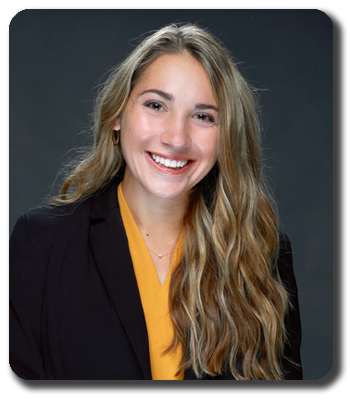
Sole Purpose 47
Dr Who? Using Your Title With Patients
Dr Who? Using Your Title With Patients
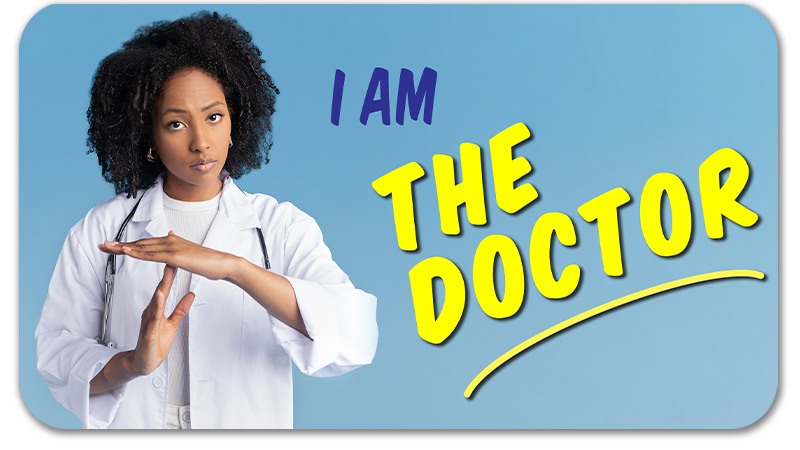
Today, I want to share a small but significant lesson I have learned early in my career. As a first-year resident, I have only recently become comfortable correcting people and ensuring that I’m addressed as "Doctor" in hospital and professional settings. Now, more experienced physicians might chuckle at this, but for me, it’s been a real challenge.
While I think this unfortunately can and does happen to anyone in medicine, it especially happens to minorities and younger physicians. After talking with several female attendings, I realized that being addressed incorrectly is practically a rite of passage for women in medicine—it happens all the time. They’ve shared stories of being called pet names like 'sweetheart,' or mistaken for the nurse, 'Ms,' or even just addressed by their first names. They shared the awkward, 'When will the doctor come in to explain the surgery?'—all while they were standing right there in the room! And this doesn’t just happen in the office or hospital—it happens in the OR, over email, and even at professional events.
While this persistent gender bias is frustrating, they reassured me to confidently and politely correct people and keep moving forward. Many also pointed out that this topic doesn’t get nearly enough discussion. So, here I am, ready to share my own experiences and dive into it!
I vividly remember a flight after graduation when the person next to me asked what I did for work. I awkwardly stammered something about being in medicine and just finishing school, but I hesitated to call myself a doctor—it felt a little too “braggy.” That awkwardness followed me into my first day as a resident, where I stumbled over calling myself "Dr Santiago" after four years of just saying “student doctor” or “Savannah.”


The first month as a resident was especially rough. I always referred to myself as Dr Santiago, but I let patients call me anything but that - Savannah, baby, sweetheart, honey. I didn’t correct anyone, because I didn’t want to come off as rude or impolite. Growing up in sports, people regularly referred to me by my last name, but in the hospital, I just couldn’t seem to make it stick.
I remember venting to some second and third-year residents about how, no matter how many times I introduced myself as “Dr Santiago,” patients just wouldn’t catch on. To make things worse, I was battling some serious imposter syndrome. I still felt like a student even though I was officially a resident—and I had my own medical students for the first time. Two guys. Naturally, they were immediately called “doctor” by the same patients who greeted me with honey or Miss (and, on occasion, more colorful language from our grumpy frequent flyers).
It was infuriating and only made my imposter syndrome worse. I couldn’t help but think, If I can’t even get a patient to call me doctor, how am I supposed to actually BE one?
During my first month, one of my students asked why I was okay with patients calling me "Savannah" or “Ms Santiago” (as my badge is clearly labeled Dr S Santiago, Podiatric Medicine and Surgery Resident and has PHYSICAN in big block letters). To this day, I have no idea how some patients find out my first name when I NEVER use it with them. I had to explain that I really wasn’t okay with it—I was just struggling to get them to call me "doctor" without feeling like I was holding up a neon sign saying, "Respect me, please!"




"I’ll admit, most patients mean no harm—they're just using terms of endearment with the best of intentions. Some have even told me my last name is 'just too hard to pronounce,' which was a bit of a shock at first. Growing up in Southern California, I’m certainly not the only 'Santiago' around! I usually handle it by saying, 'It’s pronounced exactly how it’s spelled,' and writing 'Dr Santiago' on their room’s whiteboard. My personal favorite is when patients accidentally call me 'Dr San Diego.' I can’t help but smile at the mix-up or mishearing and the unintended homage to my hometown.
In the beginning, I’ll admit a lot of this was actually a ME problem. I wasn’t correcting them—I felt awkward, and my confidence wasn’t quite there yet. But at the end of the day, my job is to be their doctor, and they should know that's my role on their care team. I'm not just their 'sweetheart' or 'honey' making rounds for fun.
My upper-level residents gave me some great advice: make eye contact with the patient and introduce myself as “Dr Santiago”—never using my first name. They also said I should avoid letting anyone call me by my first name in front of patients. So, I followed their advice, and let me tell you, it felt awkward. I hate correcting people. Additionally, I stopped writing my full name on the whiteboard in patient rooms—just "Dr Santiago - Podiatry." If the nurses needed my full name to send me a message, they could always check the last progress note.
Slowly but surely, though, I found my footing. As my confidence grew, it became easier to correct patients politely and quickly when they referred to me by the wrong name. I’d correct them, say that “it is Dr Santiago” and throw in a light joke, we’d share a laugh, and the awkwardness would pass. I’m totally fine with my students, nursing, OR staff, etc, calling me just Savannah since most of them know me personally, but none of them ever do it in front of a patient—they get it.


And just to be clear, I’m not on a crusade to make the whole world call me "Dr Santiago." But in the hospital, it matters. And I’ve learned it’s okay to ask for the respect that comes with that title. I also have learned that, even if I don’t feel it all the time. I walk into the room as THE doctor who wants to help the patient. It helps my bedside manner, clarifies things for the patients and makes everything go smoother.
Okay, But Why Does This Even Matter?
A study by Dr Stav Atir on "How Gender Determines the Way We Speak About Professionals" found that people are TWICE as likely to refer to male professionals by their last name compared to female professionals. This was consistent across fields like medicine, science, literature, and politics. They ran several studies examining whether people were more likely to use someone's first or last name in different settings, and the results were eye-opening. That small difference—first name vs last name—correlated with perceptions of trust, status, and even whether the person was deemed “more deserving” of career-related awards.

Think about it: we say "Darwin" when referring to the scientist, but it’s "Marie Curie" or "Madam Curie" when discussing her contributions. In politics, we often say "Trump," "Biden," or "Obama" without hesitation, but it's "Kamala Harris" or just KAMALA or "Hillary Clinton” or just HILLARY. We’ll throw around "Shakespeare" by only his last name, but it’s always "Jane Austen," full name, for the literary queen. These subtle differences speak volumes about how we perceive authority and competence, and the research backs it up, that it actually has a perceived difference. It wasn’t until I read Dr Atir’s article that I realized—my goodness, I do this all the time! I have NEVER called an attending by just their first name, but I often will use a female full name, Dr Savannah Santiago, instead of just Dr Santiago.
So, when patients call me "Savannah" instead of "Dr Santiago," it’s not just a personal preference—it taps into these deeper, ingrained patterns of how we assign authority. It’s about making sure I’m recognized as the doctor in the room, not just a friendly face there to chat. Sure, I’ve got a long way to go in my career and tons left to learn, but I’ve also put in the years of schooling to earn the title "Doctor." I’ve got an NPI number, I take call, I work at a hospital where I get a paycheck, and I even have a diploma that says I’m a Doctor of Podiatric Medicine. I shouldn’t feel guilty or awkward about using the title I’ve earned.
Now, I’m not going to get in anyone’s face or raise my voice if they call me the wrong name. But I can—and will—politely remind them, I’m Dr Santiago. It’s a small correction, but an important one. So, to any fellow new residents struggling with this, I feel you—and I’m thrilled to be your peer, Dr insert your last name.


- Atir S, Ferguson MJ. How gender determines the way we speak about professionals. Proc Natl Acad Sci USA. 2018 Jul 10;115(28):7278-7283. doi:10.1073/pnas.1805284115
Follow this link
Overall sponsorship of PRESENT Podiatry was made possible through
the support of our sponsors:

















Comments
There are 0 comments for this article