

Practice Perfect 891
The Issue with Biotin
The Issue with Biotin


Let’s talk medicine. Many podiatrists recommend biotin as a supplement to improve skin and nail growth. For example, some patients with onychauxis may demonstrate improved nail appearance with a biotin supplement. However, there is a problem with biotin: in patients with hypothyroidism (often the very patients with thin, easily damaged nails), taking biotin may cause abnormalities in thyroid lab values. In fact, it may actually cause abnormal results in many lab tests.
As I was researching this topic, I went down a pretty deep rabbit hole that had me reading about biotin, bacteria, immunological testing, and a number of other topics. So, this issue is somewhat technical and biochemical in orientation. For those less interested, I suggest skipping right to the end to read the “recommendations” section. For those willing to go down the rabbit hole a bit, let’s go!





Biotin
Before talking about the lab testing issues, here’s a quick review about biotin.1,2,3 We’ll use these same citations to discuss the further details below.
- Termed Vitamin B7 or Vitamin H.
- Adequate daily intake is 30 mcg/day.
- It is an essential cofactor in various enzymatic carboxylation reactions, so it is used in a large number of body processes.
- Biotin is absorbed via the gastrointestinal tract, reaching its peak levels at 2 hours and then is 100% bioavailable.
- Primarily renally excreted (watch out in patients with chronic renal disease).
Streptavidin/Biotin Assay
So, how does biotin interfere with certain lab tests? First, it’s important to understand some of the chemistry of the streptavidin/biotin (SA/B) immunofluorescence assay. This test is used commonly in laboratory medicine, not only for testing thyroid levels (free T4, T3, and TSH), but also parathyroids, reproductive hormone testing, beta-HCG, cardiac hormone, tumor markers, anemia markers, autoimmune diseases, and immunosuppressive drug levels.
Streptavidin is a molecule derived from the bacterium Streptomyces avidinii, and it is a tetramer that has a very strong binding affinity for the biotin protein. Because one streptavidin can bind four biotins, as shown in Figure 1, it allows small chemical signals to be greatly amplified, allowing more sensitive tests with less sample needed.
Immunoassays, like SA/B involve the specific binding of an antibody to an antigen, as shown in Figure 1. An antibody specific to a chemical to be tested (ex TSH shown in brown) that had been previously linked to a biotin molecule (biotinylated) is then ready to bind to the chemical during the test. A second antibody linked to some detectable technology (such as a radioisotope shown as an orange star), is introduced during the test to see a reportable result.
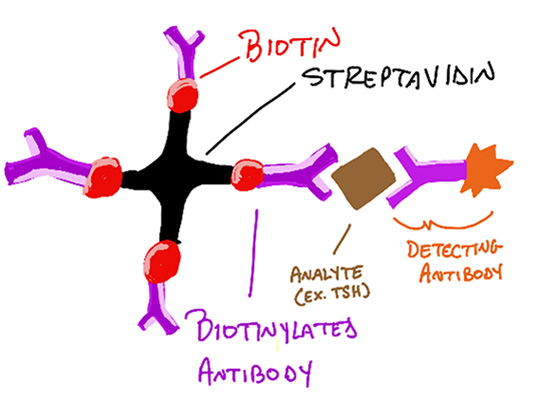
Immunoassays come in several forms, but two that are pertinent to our discussion are the “sandwich” and the “competitive inhibition” assays. In a sandwich assay, the substance being tested ends up attached, or sandwiched, between two antibodies. This is the type shown in Figure 1. Larger proteins are detected with this type of test. Examples include thyroid and home pregnancy tests. The amount of signal is directly proportional to the amount of tested substance binding to the complex.
In the competitive inhibition method, which examines small molecules, the test substance binds to the antibody on the SA/B molecule. A known amount of biotin is then added to the mixture. Since the test substance (the analyte) is already bound, the biotin cannot bind. This leads to a larger signal by the biotin molecule. If, on the other hand, there was only a small amount of the analyte, biotin would have bound more completely, resulting in a lower signal. The size of the signal that is reported, then, is inversely proportional to the amount of substance being tested.
How Biotin Interferes with Assays
An excessive amount of biotin in the blood will interfere with both the sandwich and the competitive inhibition types of assays with opposite results.
Sandwich immunoassay – extra biotin attaches to the streptavidin part, leaving these areas free of biotin conjugated to antibody that would have detected the protein that was under testing, as shown in Figure 2. This leads to less available sites for the analyte to attach and an inaccurately lower test result.

Competitive immunoassay – the binding of the extra biotin occurs in much the same way as with the sandwich assay, except this leads to a larger amount of analyte bound to the detecting antibody, leading to an inaccurately larger signal.
As a result of these interactions, the incorrect test results are either inappropriately elevated (for tests using the competitive assay) or inappropriately decreased (for the tests using the competitive sandwich assay).




Recommendations
- Question patients about what oral supplements they take. Include asking about biotin supplementation and the dose of biotin if taking.
- Hold supplements with biotin for at least 48 hours before obtaining blood tests (for typical doses).
- Hold biotin for at least 1 week if the patient is taking biotin > 100mg/day.
- Contact the lab if the physician is concerned that biotin levels were high at the time of blood testing.
Like many things in life, the simple answer may have significant complexity underlying it, and biotin is no exception!
Best wishes.

Jarrod Shapiro, DPM
PRESENT Practice Perfect Editor
[email protected]


-
Samarasinghe S, Meah F, Singh V, Basit A, Emanuele N, Emanuele MA, Mazhari A, Holmes EW. BIOTIN INTERFERENCE WITH ROUTINE CLINICAL IMMUNOASSAYS: UNDERSTAND THE CAUSES AND MITIGATE THE RISKS. Endocr Pract. 2017 Aug;23(8):989-998.
Follow this link -
Bowen R, Benavides R, Colón-Franco JM, Katzman BM, Muthukumar A, Sadrzadeh H, Straseski J, Klause U, Tran N. Best practices in mitigating the risk of biotin interference with laboratory testing. Clin Biochem. 2019 Dec;74:1-11.
Follow this link -
Luong JH, Vashist SK. Chemistry of Biotin–Streptavidin and the Growing Concern of an Emerging Biotin Interference in Clinical Immunoassays. ACS Omega. 2019 Dec 18;5(1):10-18.
Follow this link



















Comments
There are 0 comments for this article