

Practice Perfect 869
Venous Leg Ulcers Which is Better: Unna Boot or Multilayer Compression Dressing?
Venous Leg Ulcers Which is Better: Unna Boot or Multilayer Compression Dressing?

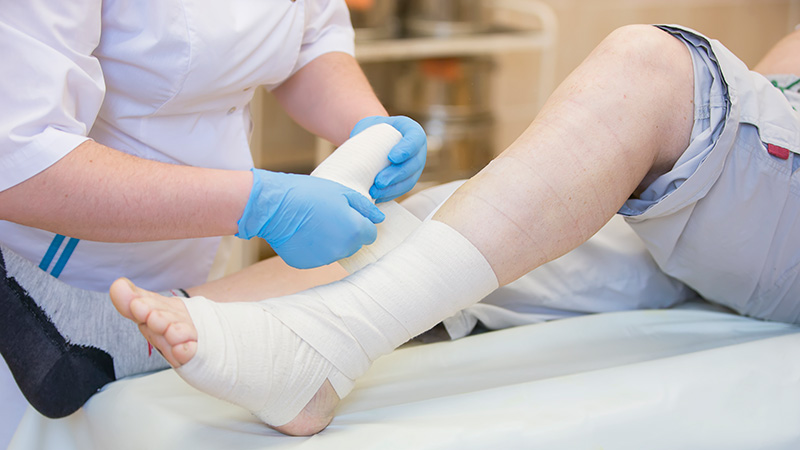
Recently, a couple of trainees and I were reviewing the application of compression dressings for venous leg ulcers. During a somewhat Socratic moment, I asked my trainees which dressing was more effective for the treatment of venous leg ulcers, the Unna boot or other multilayer compression dressings? I can tell you which is more expensive, but I didn’t know an evidence-based answer as to which is more effective. Like any good teacher, I suggested my trainees look it up, but here’s my review of the subject. I can’t but help to interject a little history into the discussion also, as you’ll see below.
What Exactly is an Unna Boot?
The Unna boot is an inelastic, static, single-layer compression gauze wrap, originally invented in 1895, composed of 15% zinc oxide in a glycogelatin-based paste1 that sometimes also contains calamine and sometimes other materials. Various other layers are applied to create multilayer compression. For venous pathology, it is applied from the midfoot to just below the knee and provides approximately 40mmHg compression at the ankle and 17mmHg at the knee. As it dries, it becomes stiff, creating what some describe as a “soft cast.”




Where Does “Unna” Come From, Anyway?
The Unna boot is attributed to Dr Paul Gerson Unna (1850-1925), a German physician from Hamburg. Dr Unna spent the majority of his career studying his passion of dermatology as one of the world’s foremost experts on the subject in a time when German medicine was at its peak. In fact, he is termed the father of German dermatopathology. Besides inventing the paste boot, for example, he also invented the enteric coated pill to allow for better absorption1.
I can’t but help mentioning that he came in contact with some other important eponyms in medicine during his training in Vienna: Ferdinand vonHebra, Moritz Kaposi, and Heinrich Auspitz. You will recall, of course, that vonHebra first described erythema multiforme with its target lesions, Dr Kaposi first defined what is now termed Kaposi sarcoma (often seen in patients with HIV and those of Mediterranean descent), and Auspitz characterized the “Auspitz sign” which is small bleeding spots when psoriatic scales are scraped off, a helpful but unfortunately not specific method to diagnose psoriasis. These three physicians were part of the first generation of the then famous Vienna School of Dermatology, and Dr Unna followed them.
Considering Dr Unna’s stature and contribution to dermatology the Unna boot is actually a minor invention, even though most of us don’t know much about his other roles as researcher and teacher.
Which is Better, Unna Boot or Multilayer Compression Dressing?
From here on, let’s abbreviate using Unna and MCD for multilayer compression dressing. Since both methods are commonly used, it’s reasonable to ask this question. In my own experience using both MCDs for venous leg disease, I have found MCDs to be much more effective due to their dynamic elasticity which allows for intermittent increases and decreases in edema. A nonelastic dressing like an Unna loses its compression when leg edema reduces. But this is just one person’s level 5 experience. What does the literature show us?
O’Meara, et al performed a Cochrane systematic review in 2013 examining various aspects of compression treatments for venous leg ulcers2. They found 48 randomized controlled trials of varying methodological quality, most of which were smaller in size and with possible bias. You would not be surprised to find out that healing venous leg ulcers (VLUs) was more successful with compression versus non-compression. In general, multi-layer compression dressings with an elastic component were more successful in terms of healing percent at 6-months and 1-year than nonelastic or single-layer versions, but these findings were based on single RCTs rather than pooled results...not the strongest evidence. When looking specifically at MCDs versus Unna, this review found 4 RCTs, and they did not find significant differences for complete healing at 3-months, 6-months, or 1 year.
More recently, a meta-analysis by Paranhos found Unna to be less effective than MCDs in terms of time to healing and total healing3. However, this study was only able to use 6 articles for the meta-analysis and only 2 studies for the healing success analysis. This study highlights the somewhat weak evidence available to us.
As a result, we can generate a couple of general statements. First, compression is superior to non-compression for the treatment of venous leg ulcers. Second, multi-layer compression dressings might be superior to Unna, but the evidence is not strong enough to say this for certain.
Compression is superior to non-compression for the treatment of venous leg ulcers, and multi-layer compression dressings might be superior to Unna, but the evidence is not strong enough to say this for certain.
So, for those of you Unna lovers out there, it remains reasonable to continue using it. The last comment to close out this discussion is the recommendation from the literature to use your Unna boots in a multi-layer fashion, applying the paste boot first, a 2nd layer of your choice (lots of options available), and a final cohesive bandage layer.





Just remember to change into clean gloves when applying that last bandage layer, so you don’t get paste all over the place!
Best wishes.

Jarrod Shapiro, DPM
PRESENT Practice Perfect Editor
[email protected]


-
Tekiner H, Karamanou M. The Unna boot: a historical dressing for varicose ulcers. Acta Dermatovenerol Croat. 2019 Dec;27(4):273-274. 1968:(Vol 2, pp 89-195). New York: Academic Press.
Follow this link -
O'Meara S, Cullum N, Nelson EA, Dumville JC. Compression for venous leg ulcers. Cochrane Database Syst Rev. 2012 Nov 14;(11)11:CD000265.
Follow this link -
Paranhos T, Paiva CS, Cardoso FC, Apolinário PP, Rodrigues RC, Oliveira HC, Saidel MG, Dini AP, Oliveira‐Kumakura AR, Lima MH. Systematic review and meta‐analysis of the efficacy of Unna boot in the treatment of venous leg ulcers. Wound Repair Regen. 2021 May;29(3):443-451.
Follow this link



















Comments
There are 0 comments for this article