

Practice Perfect 868
Adventures in Lawn Mowing
Adventures in Lawn Mowing
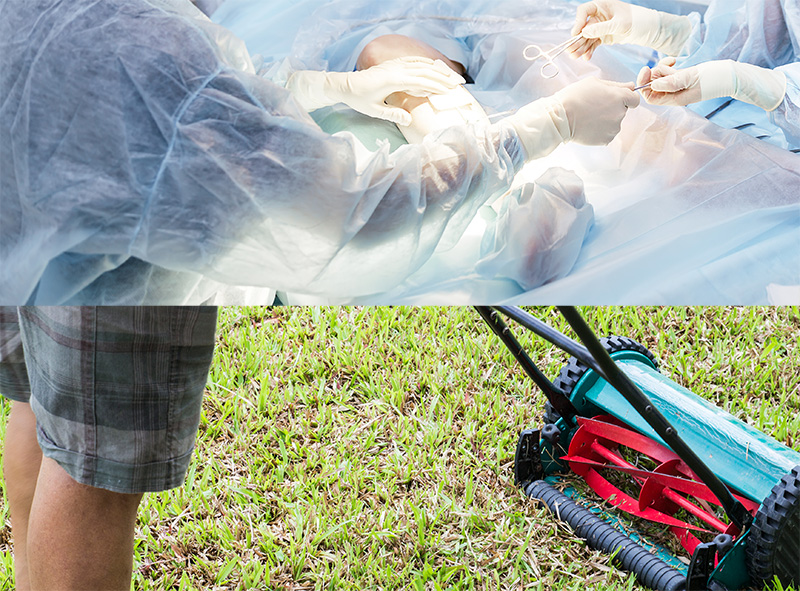
I can imagine from the title of this piece that you're expecting an incredibly exciting, rip roaring, wild ride. More likely you're thinking, "Why is this person who normally writes about podiatric medicine and surgery, wasting my time talking about mowing lawns?" Well, if you hang with me for a few minutes, I'll try to show you the deep, universal connections between lawn mowing and the practice of podiatric medicine.
Over the last few years, my family hired a local lawn mowing/gardening service, as is common in suburbia. In Southern California, we don't have giant lawns, but between the lawn, bushes and weeds, they come in handy. Additionally, a few years back my wife fired me from my lawn mowing pursuits, stating there were more profitable ways to spend my weekend time. She also thought I didn't do such a great job. With a little resentful resignation (she was correct on both fronts), I hung up my gardening gloves and got rid of the lawn mower.





Fast forward several years, and my family was - until recently you will see - working with a gardening service. They would come out every other week and take care of the "grounds". Unfortunately, it became apparent over time that they were doing a terrible job. They cut the grass so short that we were starting to see brown patches. We also noticed unwanted destruction of our backyard gardens and strange overgrowth of our back hedge. Well, it came to a head one day when my wife came back in the house, post gardening appointment, holding her prized, expensive, Belgian flowers.
"Aren't those supposed to be in the ground?" I asked.
"They destroyed my garden!" my wife yelled, not even responding to my oh-so-funny comment.
It was the last straw, and we summarily fired the gardeners.
And my lawn mowing adventure began.
Yes, friends, I was back in business, as the friendly neighborhood Shapiro residence lawn mower! I initially had mixed feelings about this, as my weekends were already somewhat busy with work-related activities. But my wife was calling for a hero, and I was going to be that person!!
Now, what does this have to do with being a podiatric physician? It's interesting that when you take a moment to stop and contemplate life, the intersections between apparently unrelated things become clear.
The first lesson I learned is the importance of distraction and a change in scenery. As you might imagine, I spend most of my time as a podiatric physician and surgeon, professor, teacher, and residency director. These activities are engaging, challenging, sometimes stressful, and mostly rewarding. Now, as rewarding as these roles are, doing something different to distract oneself from the weekly grind can be a very healthy activity. Lawn mowing is a physical activity as well as somewhat monotonous, so it relaxes the brain. Although my lawn is not large, it has a highly variable terrain, making it a little harder work than if it were flat. This physical exertion forces my mind away from my regular worries, and I find it to be a welcome break.
The power of persistence and preparation is the second and third lesson. Because I apparently like to do things the hard way, I purchased a rotary lawn mower. Don't know what that is? I didn't either...until now. Simply put, a rotary mower is a manual device (rather than the typical electric or gas mower) in which the blades are directly attached to the wheels. Pushing the lawn mover turns the wheels causing the blades to spin, cutting the grass. Now, I'm not a luddite, and I'm not a glutton for punishment - I like power as much as the next person. But this device was a lot cheaper than buying a power mower. However, learning to actually use it correctly did take some time and persistence. It required adjusting the height of the blades (another manual process) and then figuring out the various maneuvers to make the mowing process more effective. For example, because of my irregular lawn surface, I have to use one foot to occasionally push the mower in a jerking motion, allowing the wheels to contact the ground and turn the blades rather than slide along the grass. Similarly, preparation required me to have additional instruments (hedge trimmer - yes, this one was electric) to make clean edges. The combination of understanding how the equipment worked, and their limitations, allowed me to modify my own methods to improve my outcomes. Sounds a lot like surgery, doesn't it?
Finally, I recalled the satisfaction of doing a job well. After a couple of weeks of my labors, the grass looked better, the green replaced the brown patches, and my wife even gave me the complement that our lawn looked better than the rest of the neighborhood! High praise indeed from a person that is not easy to please (remember, she fired me a few years back)!





I think you can now make that easy jump from the lessons I learned lawn mowing to everyday life as a healthcare provider. Distraction from our everyday pressures is very healthy. Persistence in all things always pays off, while preparedness is an essential skill that pays dividends. And, of course, the satisfaction of a job well done, especially after a lot of hard work, can't be overstated. Good luck on your next "lawn mowing" episode.
Best wishes.

Jarrod Shapiro, DPM
PRESENT Practice Perfect Editor
[email protected]





















Comments
There are 0 comments for this article