


Sole Purpose 106
Stress Fractures
Stress Fractures
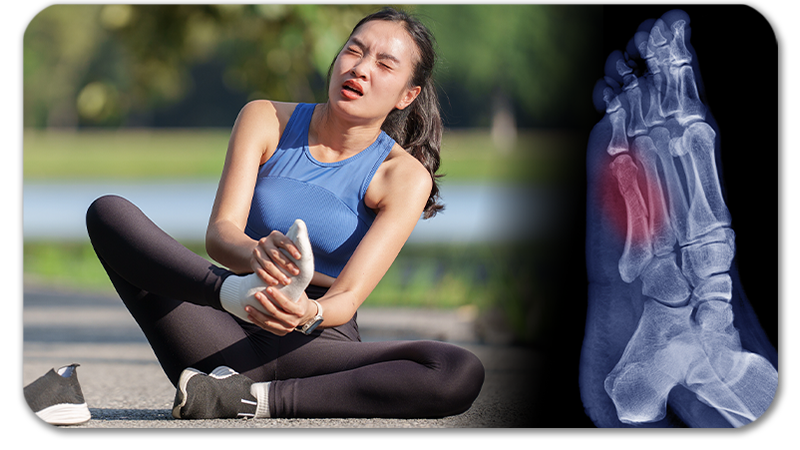
One of my all-time favorite topics to lecture on and talk about is relative energy deficiency in sports (formerly known as the female athlete triad). I wrote a longer article on the topic of treating our athletes, Sole Purpose 92 - Treating Female Athletes, that you can read. But I was recently talking to a very impressive and close runner friend who asked me what I would do if I was diagnosed with another stress fracture. Now I am no stranger to stress fractures, I have had several throughout my years of running and multiple metatarsal stress fractures that led to me spending 8+ months in a CAM boot and cast in undergrad as a college cross country and track runner is part of what led me to podiatry (a silver lining I am forever grateful for).
Now as a much more educated podiatrist I want to write todays article on what I would do if I was to get another stress fracture and what I would do for a patient.
1. Look at the red flags
Stress fractures are not something that should “just happen”—even though many of us were told exactly that in high school and college running. More often than not, they’re a signal that something bigger is going on.
As I mentioned in my previous article, BMI can be helpful, but it’s far from the full picture. One of the most important questions to ask is whether a female athlete is having regular menstrual cycles. If she isn’t, that’s a red flag for low energy availability—whether from overtraining, underfueling, or both. It needs to be said clearly: it is not normal to lose your period. It’s not a badge of honor, and it’s not safe.
It’s also important to ask about prior injury history. A previous stress fracture increases the risk of another by up to five times. And zooming out, female athletes already carry a higher baseline risk—about 3.5 times greater than their male counterparts.1 These aren’t small details; they’re critical pieces of the story that should guide how seriously we evaluate and intervene.


2. Ask about training
Are they overtraining? Did they ramp up their mileage too quickly? These are simple questions that often uncover the root of the problem. A good general rule is that weekly mileage should only increase by about 10–20%, with the longest run making up no more than 20–30% of total weekly volume.
For many athletes—especially those training for their first race—this structure isn’t intuitive. Even with widely available training plans, it’s easy to do too much, too soon. I see this all the time in athletes coming back from injury, pushing through pain or accelerating their return out of fear of losing fitness.
This is also where the conversation naturally extends beyond just mileage. How does the athlete respond when you ask about cutting back? About rest? About taking time away from their sport? Their reaction can tell you just as much as their training log.
I know for me, even now as a non-competitive runner, I can feel a shift in my mood and energy if I go more than a few days without movement. That relationship with exercise runs deep—and it’s exactly why these conversations matter.
3. Are they doing any strength training?
When I was in college, I regularly lifted 2–3 times per week. If I’m being honest, in my slower, more fatigued resident-runner era, I’m lucky if I get there twice a week—and revisiting this research honestly makes me want to head straight to the gym after finishing this article.
Weightlifting is one of the most effective tools we have for preventing stress fractures. It improves bone mineral density, strengthens surrounding musculature to better absorb impact, and helps correct biomechanical imbalances. But what’s even more compelling is that its protective effect goes beyond just bone density. In a 2025 study of 492 female athletes examining resistance training, bone mineral density, and stress fracture risk, athletes with a longer history of consistent resistance training—especially those who started as early as junior high—had significantly lower rates of stress fractures. Interestingly, higher bone mineral density alone didn’t fully account for this reduced risk, suggesting that early and consistent loading builds a more resilient system overall.2
In other words, it’s not just if you strength train—it’s when you start and how consistently you commit to it over time.




4. Recommend they speak with a mental health professional
If there are any signs of overtraining, under fueling, disordered eating, or body image concerns, it’s worth involving a mental health professional early. These patterns rarely exist in isolation, and addressing only the physical injury without the underlying drivers is often where we fall short.
I can say from personal experience—what might sound “minor” on the surface doesn’t always feel that way. When I was injured in college, it felt isolating. My entire routine changed overnight. I wasn’t able to do the thing I loved most, and suddenly there were bigger worries layered on top—scholarships, performance, how quickly I could get back. It created a level of anxiety I wasn’t prepared for. We were fortunate to have access to a sports psychiatrist through our team, and looking back, that support mattered more than I realized at the time.
It’s also important to recognize that for athletes struggling with fueling or disordered eating, injury can actually make things worse. When you remove their primary outlet for energy expenditure, it can intensify restriction, anxiety around food, and loss of control.
Even now as a hobby jogger, I have to remind myself that rest is not regression—and that taking care of your body, fully and holistically, is part of being a strong athlete, not a weak one.
5. Get labs
This is one of the most overlooked—but most actionable—parts of the workup.
With an estimated 35–40% of Americans deficient in vitamin D, it’s not optional—it’s essential.3 I didn’t think twice about vitamin D when I was running daily under the sun in San Diego. Now, living and training through Midwest winters, supplementation isn’t a luxury—it’s part of staying healthy.
Minimum lab workup for athletes with stress fractures:8
- Vitamin D
- CBC
- Iron panel with ferritin
Expanded workup (if RED-S is a concern):6
If your patient has two or more risk factors—low BMI, menstrual dysfunction, disordered eating, or recurrent stress fractures—dig deeper. You’re no longer just treating a bone; you’re evaluating a system under stress. All of the above, plus:
- Endocrine: TSH, morning cortisol
- Reproductive hormones: Estradiol, FSH, LH (females); testosterone (males)
- Bone turnover markers: Osteocalcin
- Pregnancy test
- Prolactin (especially if amenorrhea is present, to evaluate for prolactinoma)
- Consider a chemistry panel if disordered eating is suspected to assess for metabolic derangements and arrhythmia risk
There’s also emerging evidence worth noting elevated creatine kinase (CK) and lactate dehydrogenase (LDH), paired with decreased osteocalcin, have been associated with stress fractures in young female athletes. Although there is this research, it is not considered routine labs for stress fractures.3
When to consider a DXA scan:
Athletes with suspected eating disorders or menstrual dysfunction lasting longer than six months.
This is the bigger picture work. Stress fractures are rarely just about bone—they’re often a signal. Your job is to listen closely enough to hear what the body is actually saying.


6. Imaging
Radiographs can lag—sometimes by up to two weeks—so a normal X-ray early on doesn’t rule out a stress fracture. This is where clinical judgment matters. Listen to the patient. Athletes who have been through this before often recognize the feeling.
I remember in college having a strong sense that something wasn’t right, even when my initial X-rays came back normal. It wasn’t until we obtained an MRI that multiple stress fractures became clear—and repeat radiographs a week later finally caught up. The takeaway is simple: if the history and exam are pointing you in a certain direction, trust that. Don’t let a “normal” early image be falsely reassuring.
7. Parents or coaches may need to step out of the room
Sometimes the most important part of the visit happens when the room gets a little quieter. Athletes—especially younger ones—may not feel comfortable being fully honest about their pain, fatigue, or emotional state with a parent or coach present.
I was incredibly fortunate to have a college coach who prioritized my well-being and gave me the time and space to heal. But I’ve also seen the other side—athletes who feel reduced to performance metrics, points, or scholarships, carrying the weight of expectations that make it harder to speak up.
I recently cared for a young athlete who, once her parent stepped out, immediately broke down in tears. She admitted she hated her sport and just wanted the pain to stop—but didn’t want to disappoint anyone. That moment changed the entire direction of her care. This helped create a space for honesty and safety to be honest.

Conclusion
Stress fractures are rarely isolated injuries—they reflect a system that has been pushed beyond its ability to adapt. While diagnosis and return-to-play timelines matter, the more important work is understanding why the injury occurred in the first place.
A complete evaluation looks beyond bone. Training patterns, energy availability, menstrual health, strength training, and psychological stress all shape an athlete’s resilience. Treating the fracture without addressing these factors risks recurrence and prolongs the cycle of injury.
This is the perspective that has shaped how I practice. Having experienced these injuries myself, I often think about the kind of physician I needed—someone who looked beyond body type and imaging and took the time to understand the full picture. That is the standard I strive for, and one I would challenge others to adopt as well.
The goal is not just to heal a stress fracture, but to prevent the next one and just maybe inspire another athlete to go into podiatry.


- Hadjispyrou S, Hadjimichael AC, Kaspiris A, Leptos P, Georgoulis JD. Treatment and Rehabilitation Approaches for Stress Fractures in Long-Distance Runners: A Literature Review. Cureus. 2023 Nov 25;15(11):e49397. Published 2023 Nov 25. doi:10.7759/cureus.49397
Follow this link - Duckham RL, Peirce N, Meyer C, Summers GD, Cameron N, Brooke-Wavell K. Risk factors for stress fractures in female endurance athletes: a cross-sectional study. BMJ. 2012 Nov 19(2)e001920. doi:10.1136/bmj.e2511
Follow this link - Liu X, Baylin A, Levy PD. Vitamin D deficiency and insufficiency among US adults: prevalence, predictors and clinical implications. Bri J Nutri. 2018 Apr;119(8):928-936. doi:10.1017/S0007114518000491
Follow this link - Miyamoto T, Oguma Y, Sato Y, et al. Elevated creatine kinase and lactate dehydrogenase and decreased osteocalcin and uncarboxylated osteocalcin are associated with bone stress injuries in young female athletes. Sci Rep. 2018 Dec 21;8(1):18019. doi:10.1038/s41598-018-36982-0
Follow this link - Nattiv A, Loucks AB, Manore MM, et al. American College of Sports Medicine position stand. The female athlete triad. Med Sci Sports Exerc. 2007 Oct;39(10):1867-1882. doi:10.1249/mss.0b013e318149f111
Follow this link - Nye NS, Kasper K, Hoang TD, et al. Metabolic workup for bone stress injury: a practical approach for evaluating bone health in athletes. Sports Health. 2026 Jan 18:19417381251398501. doi:10.1177/19417381251398501
Follow this link - Tenforde AS, Fredericson M. Influence of sports participation on bone health in the young athlete: a review of the literature. PM R. 2017 Sep 3(9):861-867. 10.1016/j.pmrj.2011.05.019.
Follow this link - Weiss Kelly AK, Hecht S. The female athlete triad. Pediatrics. 2016 Aug;138(2):e20160922. doi:10.1542/peds.2016-0922
Follow this link
This blog and the overall sponsorship of PRESENT Podiatry was made possible through the support of our sponsors:








Comments
There are 1 comments for this article
this article stressed me out