

Practice Perfect 677
Can Patients Fly After Foot and Ankle Surgery?
Part 2: What’s the Risk After Foot and Ankle Surgery?
Can Patients Fly After Foot and Ankle Surgery?
Part 2: What’s the Risk After Foot and Ankle Surgery?

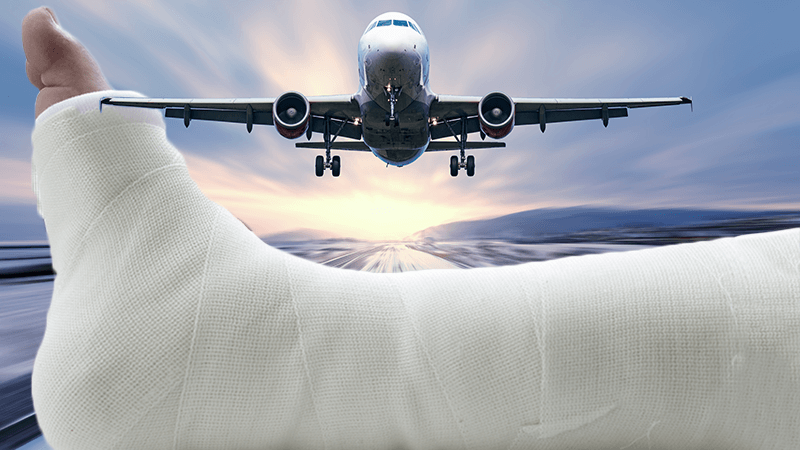
Ah, the joys – and risks – of travel. Unfortunately, we can’t plan our life events around lower extremity surgery. Situations where the foot and ankle must be immobilized often can’t be avoided, but that doesn’t mean life stops there. Modern life, and our ability to travel long distances quickly, forces medical providers to be cognizant of the risks of venous thromboembolic events (VTE). To that end, last week we discussed the increased risk of VTE in all patients who travel (2-4-fold increased risk) and the much higher risk when one stacks on patient-specific characteristics such as taking oral contraceptives and obesity. Today, though, as promised, let’s focus on the risk of VTE during travel after foot and ankle surgery.

Remember that cliffhanger I mentioned last week and my promise to answer today’s question? Well, we’re all going to have to keep hanging on, and I’m going to break that promise right from the start because, unfortunately, there are no specific studies examining the incidence of VTE associated with traveling after foot and ankle surgery or immobilization. But we can gather the associated indirect evidence and come to some conclusions.
Two reviews found the overall incidence of symptomatic VTE after foot and ankle surgery – unrelated to travel - to be less than 1% (actually 0-0.55%)1,2 one of which mentioned air travel without specific evidence of support for an increased risk2. It’s likely that the VTE risk after foot and ankle surgery is somewhat higher due to immobilization, nonweightbearing, and the vascular changes after surgery. However, we don’t know what the level of risk is.

Consider one thought, though. If we extrapolated the “recent surgery” travel DVT risk of up to 3x mentioned in last week’s Practice Perfect to foot and ankle surgery, we would have an estimated risk of only 1.66%. That’s still very low. In contrast, if we extrapolate oral contraceptives, the largest risk factor of up to 20x-increased risk, to foot and ankle surgery, the risk would now be 11%. I take from this speculative calculation that the risk of a VTE during travel after foot and ankle surgery is very low, but, like all other situations, increases significantly when we stack on other risk factors.



What About Prophylactic Compression?
Ok, so the risk of travel related VTE is likely low for most of our patients, but are there treatments or interventions that might decrease this risk? A systematic review by Hsieh and Lee looked at randomized controlled studies comparing graduated compression stockings with a control in patients undergoing airline travel3. Nine studies fit their criteria. They found graduated compression stockings significantly reduced the risk of deep venous thrombosis but not superficial venous thrombosis in airline travel participants. Using other compression therapy methods during travel hasn’t been studied, but one might use the results of this study to consider postoperative compression dressings like the Jones dressing to have a similar protective effect. This is also a benign option with few to no adverse effects – a safe recommendation for traveling patients.
Or Medical VTE Prophylaxis?
Would aspirin or a low molecular weight heparin (LMWH) be an appropriate prophylactic for our postoperative traveling patients? There is very little quality data to answer this question other than the LONFLIT-3 study4. This was a randomized controlled study that compared the use of aspirin 400mg daily for three days, started 12 hours prior to flight, to one dose of enoxaparin (injected 2-4 hours before flight), to a control group of no treatment for the prevention of DVT during airline travel in high risk patients. Of 82 subjects in the control group 4.82% had DVTs (one superficial VTE). In the enoxaparin group (82 patients) there were no DVTs (one superficial VTE occurred). The aspirin group had 3.6% VTE (one of which was a DVT). Interestingly, 85% of the DVTs were noted in non-aisle-seated patients. Based on this study, high risk traveling patients would be best prophylaxed with a single dose of a LMWH.

Bottom Line Recommendations
In the aggregate, from all the information provided thus far, it seems the bottom-line recommendations we can make to our patients are as follows. For any patients reading this, always speak to your medical provider before making medical decisions.
- Consider a patient’s medical history and comorbidities first. These conditions may significantly increase the risk of a VTE during any type of travel. For example, we now know that a young woman on oral contraceptives is at much greater risk for VTE while flying than those post-op foot and ankle surgery, all other factors being even. Patients with these comorbidities should be advised against any travel after surgery.
- For those patients at risk who plan travel anyway, consider a LMWH as prophylaxis and advise these patients to get up and move during the flight.
- Otherwise healthy patients who underwent foot and ankle surgery in the last 6-8 weeks should be cautious about travel but may proceed.
- Recommend a compressive dressing on the surgical limb during travel (if still in this stage of postoperative recovery) and a gradient compression stocking on the other side if there are concerns.

Don’t forget that these recommendations are made off rather sparse literature, and none of it from research about the foot and ankle. As such, providers should always discuss the risk/benefit ratio with their patients and consider all options together. A carefully considered plan that empowers joint decision-making is always the best option.


-
Mangwani J, Sheikh N, Cichero M, Williamson D. What is the evidence for chemical thromboprophylaxis in foot and ankle surgery? Systematic review of the English literature. Foot (Edinb). 2015 Sep;25(3):173-178.
Follow this link -
Wukich DK, Waters DH. Thromboembolism following foot and ankle surgery: a case series and literature review. J Foot Ankle Surg. 2008 May-Jun;47(3):243-249.
Follow this link -
Hsieh HF, Lee FP. Graduated compression stockings as prophylaxis for flight‐related venous thrombosis: systematic literature review. J Adv Nurs. 2005 Jul;51(1):83-98.
Follow this link -
Cesarone MR, Belcaro G, Nicolaides AN, Incandela L, De Sanctis MT, et al. Venous thrombosis from air travel: the LONFLIT3 study: prevention with aspirin vs low-molecular-weight heparin (LMWH) in high-risk subjects: a randomized trial. Angiology. 2002 Jan-Feb;53(1):1-6.
Follow this link



















Comments
There are 0 comments for this article