

Sole Purpose 34
Preparing for Residency Interviews With the 100 Landmark Articles of Podiatry
Preparing for Residency Interviews With the 100 Landmark Articles of Podiatry

Today, I want to focus on an essential topic and resource for preparing for externships and residency interviews – and focus on Diabetes. There's a PDF circulating among podiatry students, often referred to as the "100 Landmark Articles”. While I can't take credit for this compilation, I thank the class of past podiatric medical students at DMU-CPMS who complied it. It was a valuable resource gifted to me during my time as a student, and I found it extremely helpful. These articles are like the foundational knowledge of podiatry—if you were stranded on a desert island and needed to defend the core surgical facts and research of the field, these would be the ones to know.
I want to share some of the articles I genuinely used and took the time to memorize parts of as a student. I'll include both articles from the "100 Landmark Articles" and additional ones I believe are beneficial for students today.
Diabetic Foot Infection/ Wounds*
Gas Gangrene*
Hallux Valgus*
Ankle Fractures*
Calcaneus Fracture*
Lisfranc*
Talus Fracture/Dislocation*
Open Fractures
Compartment Syndrome*
Pes Planus*
Pes Cavus*
1st MPJ (gout, osteoarthritis, dislocation, trauma)
Septic Joint
5th metatarsal*
Rheumatoid Arthritis*
Lateral Ankle Instability*
Gun Shot Wound
Achilles Tendon Rupture*
Clubfoot*
Vertical Talus*
Necrotizing Fasciitis
OCD Talus*
Charcot*
Total Ankle Replacement*

This is obviously a very extensive list, and you don’t need to know every single detail about every topic. However, having a general background on each subject is important. During my 10 interviews, it felt like I was asked about everything under the sun. Having even a little bit of practice running through any of these cases even once can help you feel a little bit more comfortable in the very daunting resident room.
How I Went About Studying for Interviews
I formed a study group with a close classmate and a friend from externships who had a similar study approach. Keeping the group small—no more than three people—was crucial to avoid overwhelming discussions and too many people talking at once. At the beginning of December (after boards, since our class took them early at the end of November), we created a calendar that outlined different topics to focus on and how often we would meet. We then compiled all of our study resources and planned out when we would review each subject. We also discussed our personal strengths and how we could support each other.
We decided to meet on zoom almost daily (we took off Christmas eve, not Christmas, I know a little intense and overzealous). The first week or so we started meeting only once and would study on our own later in the day. The week before interviews, we were meeting twice a day.




START EARLY
Most externships include a Journal Club, which is a fantastic opportunity to start building your knowledge and repertoire of journal articles. I personally use a "critical reading" sheet whenever I read articles, which helps me evaluate the article and track key points. Dr Brandon Brooks has an excellent journal book available online, called “ACPM Journal Club Notebook: The Gold Standard in Podiatric Medical Education” that covers basic biostatistics (AMAZING background knowledge) and includes questions to fill out for each article you read. You can purchase it on Amazon by selecting this link.
How Study Sessions Worked
Our study sessions took place on Zoom with our group of three. We would start by each going through a case, proctored by the other two, while one person took notes on any possible mistakes or incorrect answers. Afterward, we would review the case together, discussing the mistakes or incorrect responses. Each of us had a turn presenting our own case, followed by rapid-fire questions where we rotated answering as we went along. After the session, we would study individually—reviewing articles, working on flashcards, or going over notes from that morning’s session. We also made sure to go over some social questions about once a week.
For every topic we studied, we aimed to find a “landmark article” that we could quickly cite to demonstrate our thorough preparation and knowledge. I'll dive deeper into this next week.

Below I attached a screenshot of the general schedule that we followed. We mostly got the cases from upper classman, school notes, our own case presentations throughout externships and the website https://prepodiatrystudy.com.
Overall
I know that the schedule I’m describing sounds overly intense and that I overdid it… because I really did. However, it paid off—I felt very confident going into my interviews. In fact, the actual interviews were mostly less challenging than the cases my friends and I threw at each other. That being said, they were still nerve-wracking, but that was mostly because I cared so much and wanted to do well.
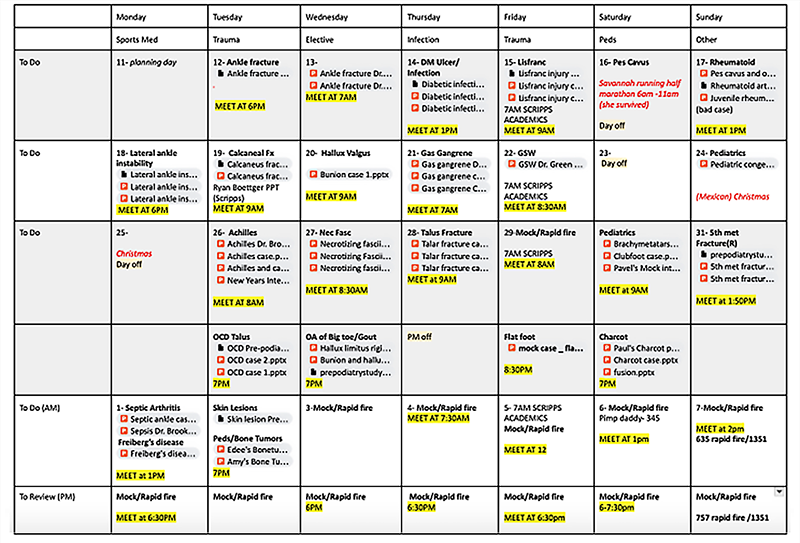
Click the image above to enlarge
In conclusion, do not forget that the last 4 years of medical school and all of your externships have prepared you for interviews and you know SO MUCH MORE than you think you do! Residency interviews are also not solely academics, they are also social. Programs want to know that they want YOU as a person, not just the student you are, and it is generally a multifactorial decision.
Stay tuned for next week when I’ll discuss the specific articles I utilized and how they helped me!


- ACPM Journal Club book
Follow this link - PrePodiatryStudy.com
Follow this link - Sole Purpose: Reading a Radiograph.
Follow this link - Sole Purpose: Social Questions .
Follow this link
Overall sponsorship of PRESENT Podiatry was made possible through
the support of our sponsors:
















- Lavery LA, Armstrong DG, Harkless LB. Classification of diabetic foot wounds. J Foot Ankle Surg. 1996;35(6):528-531.
Follow this link - Armstrong DG, Lavery LA, Harkless LB. Validation of a diabetic wound classification system: the contribution of depth, infection, and ischemia to risk of amputation. Diabetes Care. 1998;21(5):855-859.
Follow this link - Grayson ML, Gibbons GW, Balogh K, Levin E, Karchmer AW: Probing to bone in infected pedal ulcers. A clinical sign of underlying osteomyelitis in diabetic patients. JAMA 1995 Mar 1;273:721-723.COULD NOT FIND PDF
Follow this link - Lavery LA, Armstrong DG, Peters EJG, Lipsky BA. Probe-to-bone test for diagnosing diabetic foot osteomyelitis: reliable or relic. Diabetes Care. 2007 Feb;30(2):270–274.
Follow this link - Kaleta, J L, Fleischli J W, Reilly CH. (2001). The Diagnosis of Osteomyelitis in Diabetes Using Erythrocyte Sedimentation Rate: A Pilot Study. J Am Podiatr Med Assoc. 2001 Oct;91(9):445-450. Retrieved Aug 28, 2024
Follow this link - Stevens DL, Bryant AE. Necrotizing Soft-Tissue Infections. N Engl J Med. 2017 Dec;377(23):2253-2265.
Follow this link - Zgonis T, Garbalosa JC, Burns P, Vidt L, Lowery C. A retrospective study of patients with diabetes mellitus after partial foot amputation and hyperbaric oxygen treatment. J Foot Ankle Surg. 2005 Jul-Aug;44(4):276-280.
Follow this link - Waters RL,Perry J, Antonelli D, Hislop H. Energy cost of walking of amputees: the influence of level of amputations. J Bone Joint Surg Am. 1976 Jan;58(1):42-46.
Follow this link - Pinzur M, Kaminsky M, Sage R, Cronin R, Osterman H. Amputations at the middle level of the foot. A retrospective and prospective review. The Journal of Bone & Joint Surg Am. 1986 Sep;68(7):1061-1064.
Follow this link - Wukich DK, Belczyk RJ, Burns PR, Frykberg RG. Complications encountered with circular ring fixation in persons with diabetes mellitus. Foot Ankle Int. 2008 Oct;29(10):994-1000.
Follow this link

Comments
There are 0 comments for this article