|
Lecture Assignment for Week 38
Monday, March 18, 2013
|
|
| 1st Year Lecture |
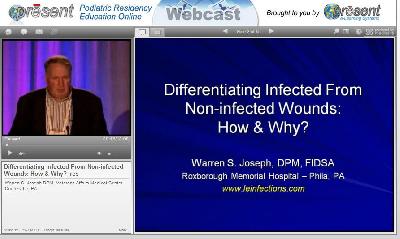
| Differentiating Infected From Non-infected Wounds: How & Why? |

Warren Joseph, DPM,FIDSA Veterans Affairs Medical Center, Coatesville, PA
CLICK ON IMAGE TO GO TO LECTURE
In this lecture, Dr. Joseph identifies the process in distinguishing infected from non infected wounds. He discusses the different treatments available for wound healing and explains the need to critically examine the literature available regarding these treatments.
This PRESENT lecture was made possible by an Educational Grant from 
CLICK HERE FOR MORE INFORMATION
|
|
| 2nd Year Lecture |
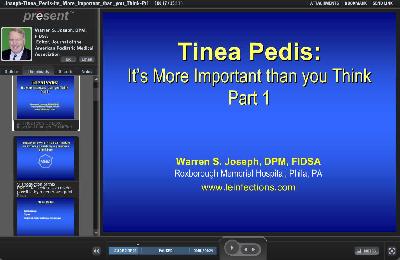
| Tinea Pedis: It's More Important Than You Think-Pt1 |
Warren Joseph, DPM,FIDSAVeterans Affairs Medical Center, Coatesville, PA
CLICK ON IMAGE TO GO TO LECTURE
This Lecture by Dr. Warren Joseph, DPM,FIDSA discusses how Tinea pedis is an infection. Just as with bacterial infections it needs to be diagnosed correctly and treated appropriately. The Focus of discussion will be the epidemiology of tinea pedis, in particular how it is inexorably linked with onychomycosis. The different clinical presentations will be explored followed by an examination of which patients are at high risk, not only to become infected but also to develop significant complications from it.
This PRESENT lecture was made possible by an Educational Grant from 
CLICK HERE FOR MORE INFORMATION
|
|
| 3rd Year Lecture |
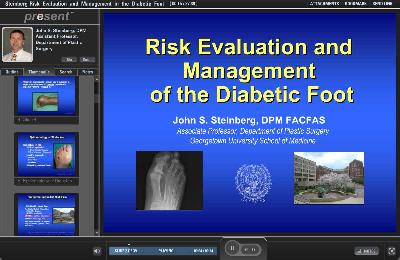
| Risk Evaluation and Management of the Diabetic Foot |

John Steinberg, DPM Assistant Professor
Department of Plastic Surgery
Georgetown University School of Medicine
Washington, DC
CLICK ON IMAGE TO GO TO LECTURE
Dr. John Steinberg provides an overview of the associated risk factors and proper evaluation of diabetic foot ulcerations. The lecture begins by discussing the epidemiology and economic impact of diabetes and diabetic foot ulcers. He then addresses the screening questions one should ask when evaluating the diabetic foot. Amputation risk factors such as infection and limb ischemia are also covered. Finally, the importance and application of the University of Texas Foot Risk and Diabetic Wound Classification Systems are explained in detail.
This PRESENT lecture was made possible by an Educational Grant from 
CLICK HERE FOR MORE INFORMATION
|
|
|
|
|
|






.jpg)